
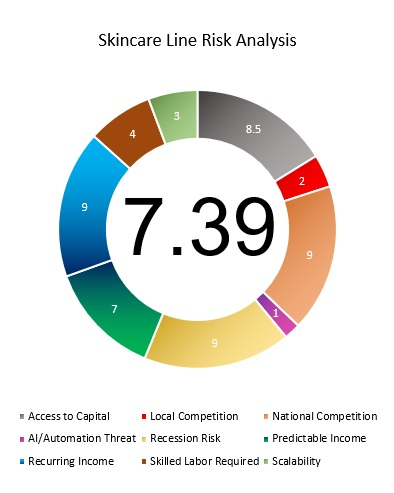
Automation – The automation risk faced by skincare lines is relatively minimal. As these are products for personal use, there is very little in the field of automation that will impact these businesses. In fact, this will ultimately be a net positive for the industry as formulations can be developed more quickly in tandem with new technologies. Furthermore, these technologies can assisted skincare lines with monitoring their marketing operations to understand which channels are having a positive impact. This will ultimately lead to a greater degree of streamlined operations, which will allow skincare line entrepreneurs to more effectively create new products.
Local Competition – While there are some local producers of unique skincare products, the competitive threat that they pose to a new skincare line is relatively low. At the onset of operations, many skincare product line developers will attend farmers markets and local gatherings to promote their products. However, this is usually a strategy that is reserved for the early onset of operations. This is typically not a long term strategy as many people seek to divest their inventories through brick-and-mortar locations while also engaging in a wide range of online sales.
National Competition – This is a major risk for any new skincare line. There are numerous multinational corporations that have gained a substantial foothold in this market. Many brands are household names, and individuals developing their own skincare line need to find ways to properly differentiate themselves from the competition. This includes the use of unique ingredients while also positioning the brand in a different capacity.
It is incredibly important to have a multipronged marketing strategy that leverages both online channels as well as traditional print channels in order to effectively reach a large audience within the anticipated demographic.
Predictable Income – This is one of the positives for a skincare line as they typically receiving predictable purchase orders from supermarkets and personal care stores once their operations are established. Additionally, many skincare line operators will engage pop up shops in order to drive early sales. The vast majority of the revenue produced from skincare lines is done so one a predictable basis. Many of these businesses operate in both a B2C and B2B capacity in order to have diversity through their operations.
Recession Risk – This ultimately depends on the pricing point of the skincare line’s products. For mid-level products, brands are able to retain their sales levels even during challenging economic climates as these products are considered to be necessities among their buyers. For higher-end products, challenging economic climates can impact operations given the middle-income people may no longer be able to afford these types of product lines. It is imperative to maintain highly controllable operating costs to ensure that an economic recession does not overtly impact the operations of the skincare line.
Recurring Income – Through online channels, skincare lines strive to produce recurring sales through auto-fill programs. However, the demand for these types of orders is limited among consumers. Most skincare line operators can expect that only 5% to 10% of their sales will come from auto-fill programs. However, if new products are frequently introduced then this may be a viable growth strategy for a skincare line. It should be noted that most auto-fill programs are arranged through the proprietary website.