
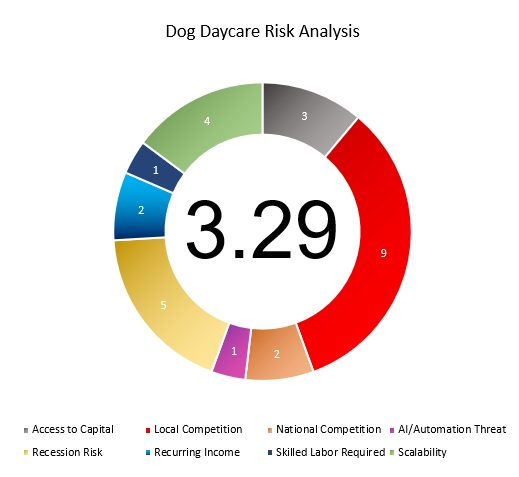
Automation Risk – Dog daycares face very little risk as it relates to automation and artificial intelligence. Pet owners are seeking caring individuals that will watch after their beloved dog on a daily basis. Additionally, as there are typically a large number of dogs at any given care facility – human beings are always required to provide proper care for these animals. The way that automation and artificial intelligence will actually benefit the industry is through the implementation of predictable analytics applied to scheduling, understanding trends within the business, and automated non-core functions that will streamline business operations.
Location Competition Risk – As it relates to local competition, this is typically the largest threat faced by any dog daycare. Most major cities typically have a number of these businesses in operation given the number of people that own dogs and need to be away from their home during the course of any given day. Most importantly, it is imperative to remain pricing competitive as it relates the daily fees for rendering dog daycare services. Additionally, many dog daycares will maintain a strong differentiating factor by providing unique facilities that are mentally and physically stimulating for a dog.
National Competition Risk – There are no major national competitors that operate a number of dog daycare centers. Although there are some franchise systems that operate within the United States, these are typically few and far between. Most dog owners preferred to work with someone that is local to them when seeking daily care for their pet.
Owner Work Life Balance Risk – The work life balance of a dog daycare center owner is very reasonable. These businesses do not typically provide overnight boarding services and they operate during normal business hours, typically from 7AM to 6 PM. As such, owners of dog daycare businesses typically have a strong work life balance. Additionally, managerial level staff can be hired to manage the day-to-day operations so that the owner does not need to remain at the facilities at all times.
Revenue Risk – The revenue that is generated by a dog care facility is highly recurring in nature. These services are typically required five days a week among busy pet owners that require proper care for their dog during the course of the day. Many locations offer both half day daycare as well as full daycare in order to accommodate the schedules of dog owners. Given the recurring nature of revenue, these businesses are able to have highly stable income streams.
Recession Risk – Recessions can have a very modest impact on a dog daycare. As these services are not an absolute necessity, individuals may use these facilities less during very challenging economic climates. However, this risk is substantially reduced in major metropolitan areas as many professionals are able to retain their job in any economic situation. Even in suburban areas, numerous professionals require the services on an ongoing basis, regardless of how the economy is doing.
Scalability Risk – Dog care businesses are typically highly scalable. Dog ownership within the United States is highly prevalent with almost 46% of households having at least one dog. As such, there is a substantial demand in any suburban or market or major metropolitan area for the services on an ongoing basis. Typically, a dog daycare entrepreneur will establish a second location once their facilities reached 90% occupancy. Generally, a second location is established within the 5-to-10-mile radius of the initial location depending on the geographic area.
Skilled Labor Risk – There is very little in terms of skilled labor that is required in order for provide proper care for a dog. Employees can be easily sourced and trained as to the proper protocols for working with a number of animals. The operation of these businesses does not require any individual to hold any specific professional certification or degree. Generally, most dog daycare center workers have a per hour rate of $15 to $20.