
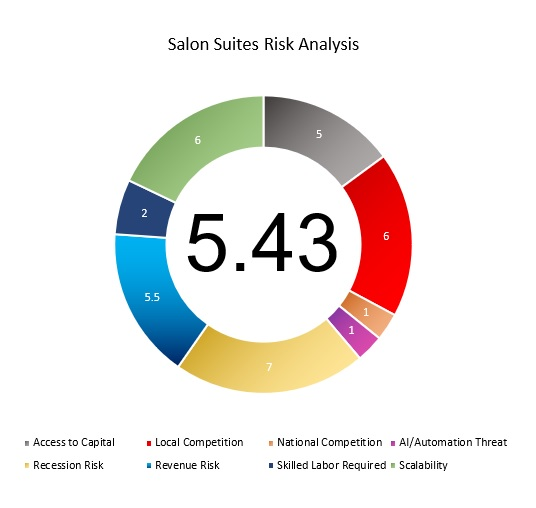
Automation Risk – The automation risk faced by salon suites businesses is minimal. Individuals are going to continue to need hairstyling and esthetician services. These services can only be rendered by a human being. As such, as relates to the continued growth of artificial intelligence technologies, as well as automation technologies, this will have absolutely no impact on an entrepreneur’s ability to establish a salon suites business. In regards to how this technology can be used, entrepreneurs that established these types of companies can leverage predictive analytics in regards to understanding the busiest times a day, products that are popular which are sold in in common areas, and ongoing seasonal demand.
Local Competition Risk – This is by far the biggest risk that is faced by any salon suites business. The company not only faces competition among entities that operate in a similar capacity, but also among traditional salons that provide hairstyling and haircutting services to the general public. The unique aspects of the salon suites business model is that third-party hairstylists and estheticians are able to render their services on site for a fixed weekly or monthly fee. This can create a significant differentiating factor, especially if numerous different types of estheticians are rendering their services on site.
National Competition Risk – In regards to national competition, there is no known entity that provides salon suites throughout multiple locations on a nationwide basis. These businesses are typically owned by individuals rather than large corporations. As such, the national level competition risk for salon suites business is absolutely minimal.
Owner Work Life Balance Risk – The work life balance for a salon suites entrepreneur is very reasonable. As these businesses operate during normal business hours, there is very little that needs to be managed outside of the standard operating times. Furthermore, salon suites produce highly recurring revenue from the ongoing rental of available units. As such, this can be treated as more of a passive investment rather than a direct operating business.
Revenue Risk – The risk related to revenue generation are relatively low for a salon suites business. The revenue that is produced is done so on a weekly and monthly basis. For many hairstylists and estheticians, they are frequently seeking places where they can conduct their proprietary service operations. It should be noted that although the income is highly recurring in nature, most salon suite businesses do not require long-term leases. This presents a more modest risk, especially among locations that operate in major metropolitan areas.
Recession Risk – Recessions can have a moderate impact on a salon suites business. Although haircutting and styling is an absolute necessity, people may seek lower cost options during challenging business climates. As such, individuals that rent spaces at these businesses may seek to work at salons during times of economic recession. However, this risk is less in major metropolitan areas that have a substantial amount of wealth and population density.
Scalability Risk – The operations of salon suite businesses are highly scalable. Once the initial location reaches 100% capacity, the owner of the business can easily establish additional locations. The primary constraint for capability is having the necessary population density in order to ensure that these developments are economically viable.
Skilled Labor Risk – Skilled labor matters are also of minimal risk to a salon suites business. This is primarily due to the fact that the only employee that is typically required to operate these businesses beyond the owner is a receptionist. All hairstylist and estheticians that conduct their operations at salon suite businesses are independent business owners. As such this risk is incredibly low. In the event that multiple salon suite locations are developed then additional support personnel from an operational and administrative standpoint is usually required. In regards to professionals, CPAs and attorneys that provide ongoing advisory services are always outsourced.