
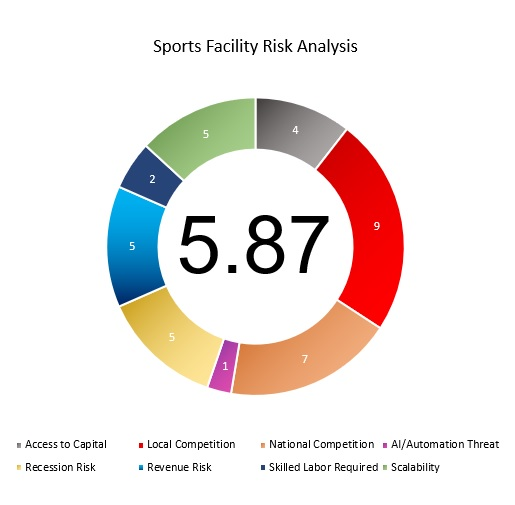
Automation Risk – The risks related to automation specific for a sports facility are absolutely minimal. This is very much a human driven enterprise and individuals are going to want to continue to go to sports facilities and sports complexes to improve their health as well as their athletic abilities. Furthermore, people will continue to want human interaction as it relates to receiving ongoing sports training or improving their sports skills. The operations of sports facilities are highly social, and many people forge deep friendships through their membership at these locations. As it relates to AI use within the field of sports complex management, this will be helpful as it relates to integrating analytics that can offer predictive insight as to the busiest times of day, inventory stocking levels, staff scheduling, and related matters based on historical inputs.
Local Competition Risk – Local competition is a significant risk for a sports complex or sports facility. In any market area, there are always a number of fitness centers, gyms, and related athletic focused enterprises that are vying for the same customers. As such, many sports complex entrepreneurs will frequently focus on finding unique ways in order to differentiate their location from that of competing businesses. At the onset of operations, this is principally achieved by offering highly competitive membership rates that drive early onboarding of clients. This can also include free use of the facility during a grand opening period in order to familiarize individuals with the location, its equipment, sports training, and related offerings.
National Competition Risk – National competition is also a major threat for a sports complex business. There are numerous nationally recognized chains that operate in a fitness center, gym, or sports complex capacity. However, while these locations are popular, they typically charge substantially more than a locally owned enterprise. Additionally, nationally operated chains often provide a wide degree of amenities that are not commonly found among locally owned sports facility locations.
Owner Work Life Balance Risk – As sports complexes typically operate during normal business hours, most entrepreneurs that establish these types of business is due and enjoy a nice work life balance. In some cases, these facilities can be open as late as ten in the evening, but this is usually a rarity for sports complex complexes that focus specifically on training for a specific activity. Sports complexes can easily hire managerial level staff that can manage the later hours of the day so that the owner can return home during evening hours.
Recession Risk – the recession risk for a sports facility is moderate. As membership these facilities typically cost $100 to $200 per month, a severe economic recession may impact an individual’s ability to afford these monthly fees. However, this can be remedied by offering drop-in passes as well as discounted membership. Additionally, many parents find the use of sports facilities to be an absolute necessity for the health and fitness of their children. As such, only is very severe and sustained economic recession would generally impact the operations of the sports facility.
Revenue Risk – The revenue risk for these businesses is also extremely low. This is primarily due to the fact that sports facilities operate on a membership basis. Furthermore, these businesses enjoy a number of revenue streams outside a membership, including fitness training fees, concessions, apparel sales, as well as drop-in passes. This diverse mix of revenue creates a very economically stable enterprise.
Scalability Risk – The operations of sports complexes are also highly scalable. Once the initial facility reaches 100% capacity, the owner can easily establish additional locations in nearby markets. The recurring reams of revenue from the initial location are able to offset a substantial amount of risk related for the development of subsequent locations.
Skilled Labor Risk – This is also a relatively low priority matter for sports facilities. The only types of skilled labor that are typically required or individuals that have an extensive amount of experience within any given sport that is taught after the facilities. In regards to general staff, these individuals typically do not need to undergo a substantial amount of training in order to understand how to properly manage their position on a day-to-day basis. The salaries that are required for the staff are relatively low as compared to the revenues of a sports facility business.