
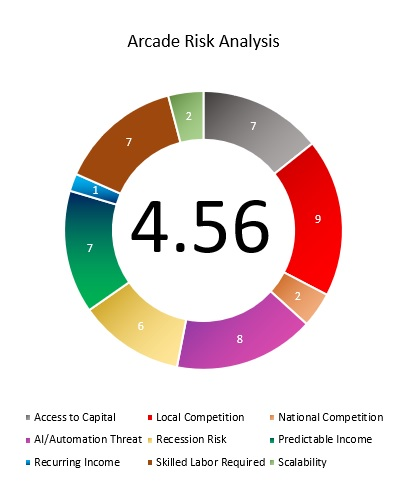
Automation Threat – This is an absolutely minimal risk for arcades. In fact, the integration of AI into state-of-the-art video gaming systems that are installed in arcades will improve the end user experience as unique games can be offered. In regards to the general operation of these businesses, automation will assist arcade entrepreneurs with analytics that will showcase which games are the most popular, which times of day are the busiest, and which food/beverage items need to be restocked. Moving forward, these types of technologies will provide deeper insight that will assist arcade owners with better planning their operations.
Local Competition – This is the greatest threat faced by arcade businesses. In any market, there will be considerable competition among established locations. In order to address this risk, many arcade owners will have a revolving line of games that further repeat patronage. Additionally, the integration of food and beverage service can provide a significant differentiating factor. The offering of premium food options has become a major trend within this industry.
National Competition – Although there are major arcade firms that span multiple states, these are typically few and far between. Most national level competitors focus their operations on major cities as they often create full scale entertainment centers. For an arcade that is located in a suburban market, this risk is mitigated.
Owner Work Life Balance – Arcades typically operate during afternoon and evening hours. This can present certain challenges for entrepreneurs that have a family. However, over a certain period of time, an assistant manager that has core competencies regarding all facets of operation can be hired to assist with the workload. As these businesses are relatively straightforward to operate, training of experienced employees for management positions is relatively seamless.
Predictable Income – The ongoing usage of arcade games, entertainment installations, and food/beverage sales provides highly predictable revenue for arcade owners. Most games having a pricing point of $0.50 to $2.00 depending on the game. Food and beverage operations, depending on the quality of the fare offered, typically ranges from $2 to $15. As noted above, numerous arcades have taken a premium approach to their fare in order to drive people to come to the location for the food. The highly predictable revenue produced from these operations provides a substantial degree of stability.
Recurring Income – Most arcades do not produce recurring income. However, this is changing as many arcades have begun to implement membership driven operations that provide access to games at no cost provided that the customer has a monthly membership. Most arcade owners view this as a secondary matter as only a handful of arcade goers typically opt for a membership driven program.
Recession Risk – One of the nice things about operating an arcade is that they are able to remain viable even during challenging economic climates. The very low pricing point associated with going to an arcade is often a substitute for more expensive types of entertainment such as a vacation. As such the recession risk for an arcade is relatively low.
Scalability – Arcade owners can seamlessly establish additional locations once their first location reaches maximum capacity. Once a brand name is established, this can be leveraged to create a new location. However, most arcade owners need to place their second location typically a significant distance from their initial location which can lead to a greater degree of operational complexity.
Skilled Labor – This is also a low risk for an arcade as most employees work in a part-time capacity outside of the owner or an employed general manager. The training required to properly onboard an arcade employee is relatively straightforward as most training protocols focus on proper customer service methods and use of point-of-sale systems. The only complex position is addressing machine maintenance although this is typically outsourced to a third-party firm.