
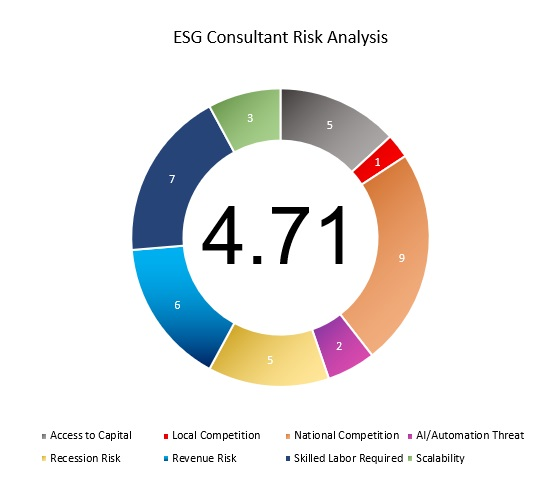
Automotive Risk – The automation and artificial intelligent risk that ESG consultant firms face is relatively low. Companies that hire types of consultants are seeking comprehensive advice in order to improve their protocols as it relates to the environment, social matters, and governance related issues. It takes a human being to conduct a complete analysis regarding the operations of their client’s business in order to properly develop procedures and protocols that will align with the core principles of ESG. In fact, artificial intelligence may be a major boost to the industry given that certain aspects of large organizations can be reviewed more quickly. However, discussing the strategies that can improve this aspect of an organization’s operations will always need to be done by a human being.
Location Competition Risk – Local competition risk is absolutely minimal for an ESG consultant. The vast majority of these firms operate on a nationwide basis and they are able to conduct their services through online communications. This is a negligible risk for this type of business.
National Competition Risk – National competition risk on the other hand is significant. The cost of establishing a new ESG consultancy is relatively low. Most importantly, and as noted above, these businesses are able to benefit from the use of numerous online marketing strategies, including targeted PPC advertising, social media advertising, and search engine optimization to drive traffic to their respective websites. As such, ESG consultants need to find ways in order to differentiate their firms from competing enterprises.
Owner Work Life Balance Risk – As with any consulting firm, there is a challenge in regards to the owner work life balance. As these businesses operate on a national and international basis, there is an ongoing need to remain on call in order to discuss issues with ongoing clients while also creating proposals for potential customers. Most ESG consultants, typically have a work week that expands anywhere from 50 to 70 hours. During the earlier of the business, the number of hours that are worked can be much higher as a business establishing its brand name.
Revenue Risk – The revenues of an ESG consultants are high marginal nature. As this is a service base business, there is very little underlying cost related directly developing plans that improved a client’s implementation of ESG principles. The primary underlying costs that are faced by these types of businesses are payroll related expenses. During the early years of operation, there is also an immense need to spend significant amounts of capital on marketing. A properly developed business plan can be instrumental with assisting related to budgeting matters. A sensitivity analysis should be completed in order to understand different scenarios regarding this risk.
Recession Risk – The recession risk for this type of consultancy is moderate. While it is extremely important to integrate ESG. principles into the operations of any organization, this is not an absolute necessity from a revenue generation standpoint. As such, the demand for the services may decline slightly during very challenging economic climates. This risk can be abated by working across numerous jurisdictions on a global basis. It should be noted that some markets do require that ESG principles are integrated into an organization based on their size.
Scalability Risk – These businesses are highly scalable. Once the ESG consulting firm develops an ongoing client base, highly qualified personnel can be hired in order to further the billable operations of the business. Additionally, offices can be established other markets if a substantial amount of face-to-face interaction is required.
Skilled Labor Risk – The skilled labor risk is also significant for these types of businesses. As providing consulting related to environment, social, and government matter matters is very complicated, there is a need to have highly qualified personnel to have a deep understanding of this consulting discipline. The cost related to onboarding a consultant that has this type of expertise is significant. As such, this is a higher risk for this type of enterprise.