1.0 Executive Summary
The first step in completing the event venue business plan is to develop an opening paragraph that speaks to the unique nature of the business. In this section, a focus should be on the timeframe in which the then you will launch its operations, the amount of capital needed to establish the facilities, the names of the founders, as well as other pertinent information that speaks to how the business will thrive once its grand opening occurs.
1.1 The Services
This section of the event venue business plan focuses on providing a brief overview of the revenue centers. In this section, a discussion regarding event venue fees should be included, as well as discussing matters related to adjust adjustments of in seasonal pricing.
If the location is going to offer catering and bar service, then a discussion about how these operations will take place can be included here as well. You can also note the contribution margins that are produced from providing the service.
1.2 Financing
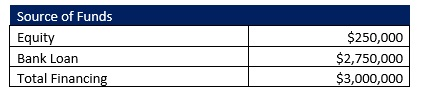
Almost all event venues require some form of financing in order to get their operations off the ground. In this section, an overview regarding the amount of debt capital in the amount of equity capital should be discussed. Typically, this section of the executive summary spans two paragraphs.
1.3 Mission Statement
As relates to the mission statement for the event venue, you can indicate the desire to provide an exceptional experience for posts in their guests. You can also discuss providing gainful employment opportunities to young people throughout the target market area.
1.4 Management Team
As relates to the management overview, providing background information regarding the owners and their ability to operate the event venue is extremely important for this section. This can include academic credentials, experience in the event venue industry, as well as unique skills that will further the operations of the business.
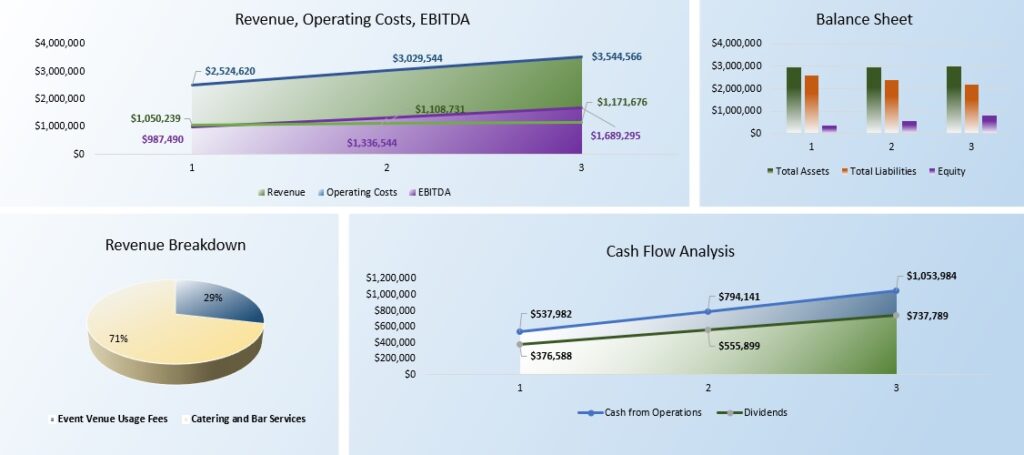
1.5 Sales Forecasts
1.6 Expansion Plan
Event venues, outside of establishing additional locations, typically only have a certain degree of growth that they can achieve during their early years of operation. Here, a discussion regarding how the business will expand its operations on a year-on-year basis can be included with a suggestion regarding the development of additional locations or increased marketing efforts.
2.0 Company and Financing Summary
2.1 Registered Name and Corporate Structure
The formal corporate name the business, the doing business as name, and the state of registration should be included in this section of the analysis.
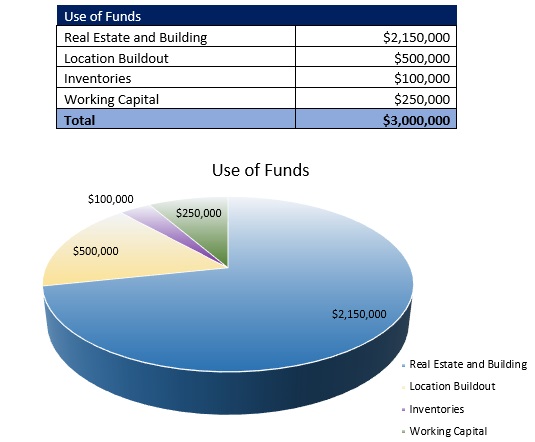
2.2 Required Funds
2.3 Investor Equity
Most of event venues require a significant amount of equity in order to establish their operations. As such, many entrepreneurs that enter this field will partner with an investor in order to provide the equity portion of the capital needed to establish operations. If this is the case for your business, then you should focus on how you intend to work with a financial partner in order to acquire this portion of the funding.
2.4 Management Equity
This section that should indicate the number of owners, their names, equity percentages, and how these tables may adjust based on the use of investor capital if this is applicable to your event venue.
2.5 Exit Strategy
As it relates to exit strategies, while most of venues remain under the ownership of management for several years and in some cases, decades, it is important to discuss the potential exit should be necessary to do so. This could include a discussion regarding the hiring of professionals that assist with this process.
3.0 Operations
The operation section of the business plan should run about one to two pages. Many people that write their own business plans often will put every procedure in protocol regarding the operations of each event within this section of the document. However, this is unnecessary. The primary focus of the event venue operation section of the business plan is to provide an outline of the revenues that are produced from each facet of operation spanning event venue fees as well as on-site catering.
This section can also be used to discuss certain aspects of the business and how it will be able to thrive once it establishes operations. Certain regulatory matters, on a more limited basis, can also be addressed in this issue chapter.
4.0 Strategic and Market Analysis
4.1 Economic Outlook
The economic section of the event venue business plan is one of the more challenging parts of the document to write given that a full examination of the economy and how it can impact an event venue business needs to be provided. Commonly, all relevant economic statistics represented should be present in this section of the document. These metrics that should include issues related to inflation, GDP growth, fluctuations in interest rate, as well as consumer spending habits.
This section can be further complemented with the discussion of contingency strategies that may be executed in the event that there is a severe economic recession and people curtail spending on large scale events.
4.2 Industry Analysis
A national level approach to the event venue industry should be taken in this section of the business plan. This includes discussing the revenues that are produced, historical trends, growth trends, as well as the outlook of the industry. It should typically span two to three paragraphs.
4.3 Customer Profile
For an event venue, having a highly defined demographic profile is extremely important. As these business businesses provide services for weddings, corporate events, and other large scale personal events, it is absolutely necessary to determine the targeted market for both individuals as well as corporate clients. This section could be complemented with statistics regarding the regional market as well as discussing the effective target market radius of how far an individual is willing to travel to the Location to host their event.
4.4 Competition
A large-scale competitive matrix should be developed for the section that showcases all competitors typically within a 25-to-50-mile radius. An analysis of each competitor should be included regarding their strengths as well as their weaknesses. This chapter is typically ends with a discussion regarding differentiating factors and competitive advantages.
5.0 Marketing Plan
A wide-ranging marketing campaign that can create significant visibility among individuals is absolutely necessary for an event venue business. In this section, the entrepreneur should take the approach of how they intend to market the operations and the business across multiple marketing, advertising, and sales channels.
Most commonly, an extensive amount of direct outreach with industry professionals is usually the first step for creating the type of visibility that is needed in order to ensure maximum capacity for the facilities.
6.0 Organizational Plan and Personnel Summary
7.0 Financial Plan
7.1 Underlying Assumptions
The underlying assumptions table should be included in this section of the business plan. Alternatively, bullet point discussions regarding the amount of capital required, the growth rate, contribution, margins, and net profit margin can be included in this section as well.
7.2 Sensitivity Analysis
Given that event venues are subject to economic fluctuation, it is important to have discussion regarding the sensitivity of the business to the economy. This includes a discussion of both optimistic and conservative scenarios, as well as addressing how the base case scenario will produce significant profitability as well as a strong return on investment.
7.3 Source of Funds
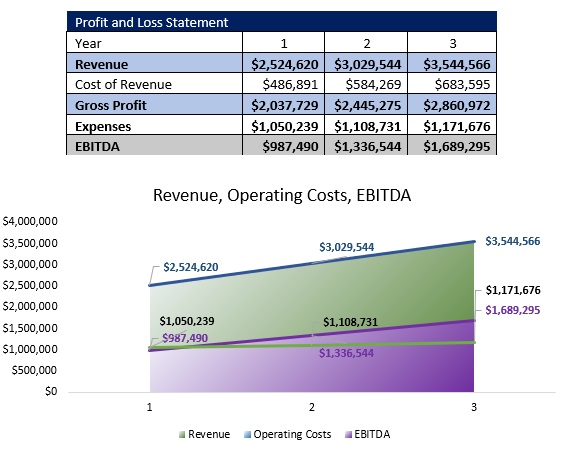
7.4 Profit and Loss Statements
7.5 Cash Flow Analysis
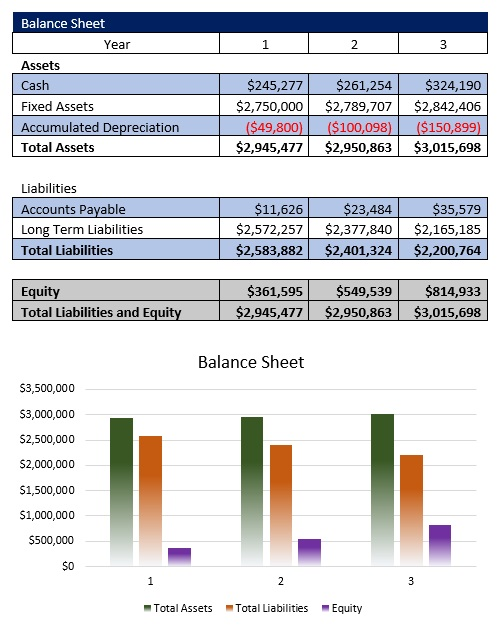
7.6 Balance Sheet
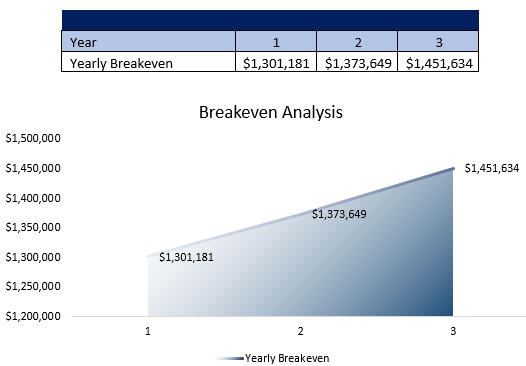
7.7 Breakeven Analysis
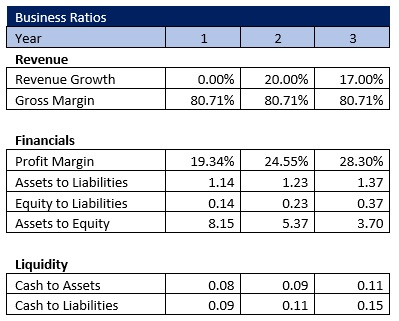
7.8 Business Ratios