
Writing a business plan for a freight brokerage is drastically different than developing a business plan for a traditional brick and mortar business. This is due to the fact that these businesses are able to operate through their services throughout the entire entirety of the United States, and they are not bound by any geographical location. Although many brokerages will maintain relationships with regional freight transportation enterprises, these businesses are able to scale across the United States very quickly. The power of the internet has allowed for a freight brokerage is to market their services to a wide spectrum of companies nationally. One of the best things about these businesses is that they are able to produce highly predictable streams of high margin revenue from the ongoing placement of loads on behalf of their clients. However, this is a competitive industry and freight brokerages must always find ways in order to differentiate themselves in the market.
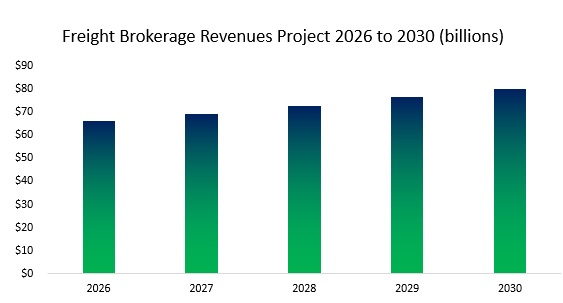
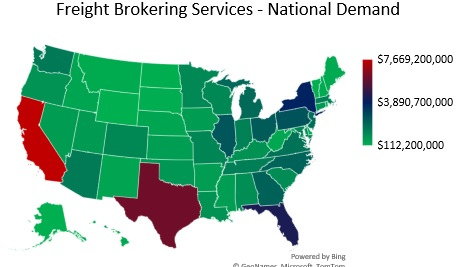
When we are engaged to create a freight brokerage business plan, one of the things that we focus on immediately is conducting the necessary market analysis. As this is a commoditized industry, we take a deep look at the industry, especially as it relates to the current state of the economy. This is complemented within an overview of the current environment and specific demand for freight transportation. Beyond this type of analysis, we also take a look at major national level competitors in order to determine the best approach for maintaining a competitive advantage, as well as implementing certain differentiating factors.
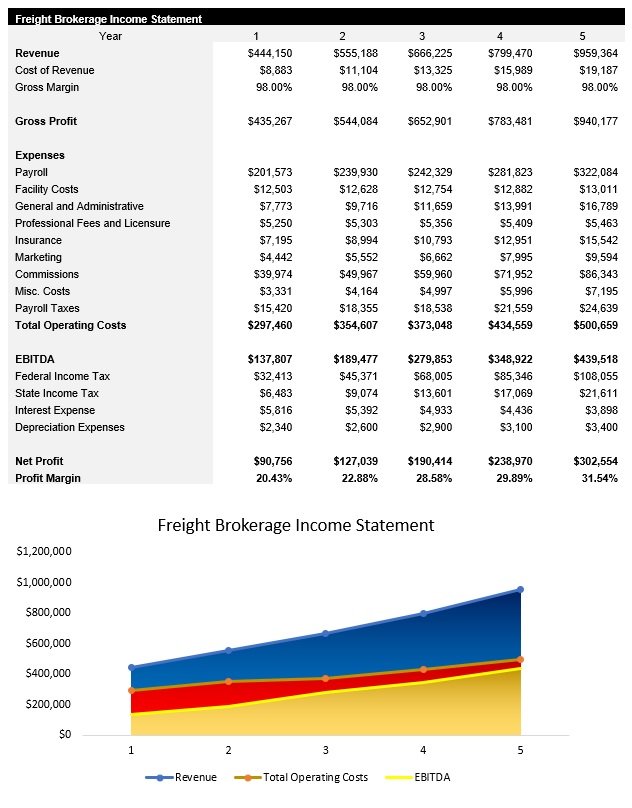
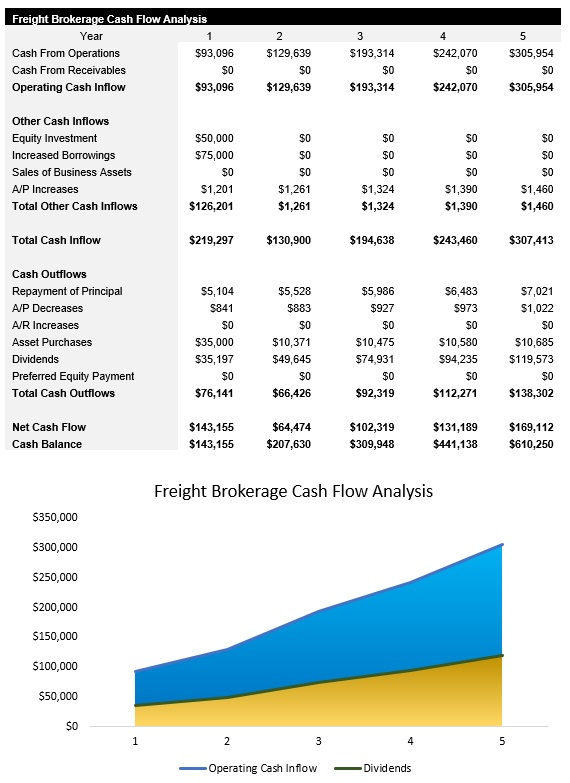
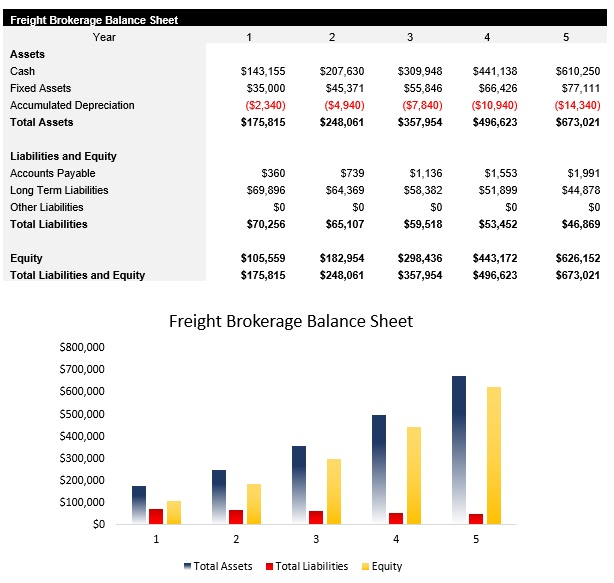
The second phase of developing the freight brokerage business plan is the development of the financial model. Here, we take a five-year approach to creating a profit and loss statement, cash flow analysis, common size income statement, breakeven analysis, and balance sheet. One of the key metrics that we use when determining revenue is the number of transportation engagements that will be arranged through the brokerage. We then determine the average value of each transportation order in order to derive the revenue number. From there, we apply in industry standards statistics in regards to operating costs including general and administrative expenses, marketing costs, as well as payroll. We also include a line item specific for commissions among staff agents that generated significant amount of business.
The third phase of the process is the creation of the marketing plan. Here, we take an online focused approach given that these businesses are able to source clients on a national level. We also discuss regional marketing strategies in regards to establishing ongoing relationships with local and regional businesses that have ongoing freight transportation needs. The scope of this discussion includes direct outreach initiatives, as well as the distribution of sales literature that showcases the capabilities of the business. This is further extended to discuss the onboarding of owner operators, as well as other types of freight transportation businesses that operate as sourced carriers.
From here, we then developed the freight brokerage operations plan. In this section, we discussed, the scope of services offered, the anticipated revenues per transaction, commission rates for staff agents, as well as regulatory matters that need to be addressed on an ongoing basis.
As we finalize the primary sections of the business plan, we then develop the SWOT analysis. Here we focus on the strengths, weaknesses, opportunities, and threats that are commonly faced by freight brokerages. For strengths, we focus on the ability to rapid the scale operations throughout the United States, especially through the use of online communication channels. As it relates to weaknesses, this is an extremely competitive industry and there are numerous national level firms that have been established for a significant period of time. The opportunities are enormous for a freight brokerage given that these businesses can expand organically through increased marketing efforts as well as acquisition. The greatest threat that faces a freight broker are negative changes to the economy.
Once we complete this section, we also developed the risk analysis chapter. Here we discuss the development risk, financing risk, marketing risk, and operational risks that are common to this type of enterprise.
Then, of course, we move to the executive summary. Although this is the first chapter, we always write the freight brokerage executive summary last as it serves as a guide and roadmap for the remainder of the document. This includes a discussion of how the business will be financed, an operational snapshot, an overview of the anticipated revenue and profit, as well as other important matters that should be addressed immediately.