Why is it important to have a business plan?
A business plan can serve as a multi-functional tool for your enterprise. Most importantly, when starting a business, you are going to want to have a complete understanding of the steps that you will take in order to bring the operations to revenue generating status while also attracting a number of potential customers. For a startup, a business plan should serve as a road map that focuses on the first five years of operation. Of special importance is the first year of operation as this will be the time where you establish your brand.
Beyond ensuring that the business has a proper roadmap for growth, the business plan can also serve as an important tool when you are securing capital. Nearly every bank or private funding source is going to want to see a comprehensive business plan that clearly showcases the market, the expected financial results, as well as a clearly designated growth plan.
Additionally, the document to serve as a vital tool when approaching potential landlords when establishing a retail or food service business. Many commercial property owners require a comprehensive business plan prior to issue in the lease.
Which chapter should I start on when I begin to develop my business plan?
The most important section is the market analysis. This is the time that you determine whether or not the business is going to actually be viable based on a number of metrics. Most importantly, it is imperative that you focus on understanding the competition that is within your local regional area. In many cases, there can be a significant saturation among enterprises that operate in an identical capacity to your planned venture.
In addition to approaching the market research from a competitive standpoint, you should also gain a clear understanding of the market as it relates to population size, population density, and median household income. These metrics are highly important as it will provide you with the ability to understand whether or not the area can remain economically viable in the event of a recession. One of the key components of a well written business plan is to address contingencies in the event that there is a challenging economic climate. It stands to reason that establishing a business within a population dense in wealthy area, typically affords the new venture with a far greater degree of economic stability.
One of the other important reasons for starting with the market research is that you are able to gain an understanding of the total addressable market. In order to complete this calculation, you can take the total amount of money spent on a per capita basis on the product or service at you are selling and multiply it by the number of people within your market that fall into a defined demographic profile. From here, you can more effectively develop a revenue overview based on this specific metric.
Besides the market research and financial modeling, what is the most important section of business plan?
By far, the most important secondary chapter of the business plan is the marketing plan. Here, you are going to clearly create the marketing messages that will establish your brand name while also resonating with a target client demographic. This is typically one of the longer sections of the business plan as it is imperative that you showcase each potential channel that you are going to use to create brand visibility. This part of the plan should include a discussion not only regarding numerous online marketing strategies that will be used, but also traditional means of advertisement as well depending on the type of business that you are starting.
One of the most important pieces of advice that we can provide to you is to establish your online marketing campaigns well before the actual launch of the business. This will ensure that you will have a significant amount of online visibility once revenue generation starts. The types of marketing strategies that you can discuss in your marketing plan include search engine optimization, use of targeted social media ads, general social media marketing, online public relation strategies, as well as video marketing.
As it relates to traditional marking strategies, this is heavily dependent on the type of business that you are starting. If you are a retail business ir food service business and you’re going to want to consider the extensive use of mailed advertisements as well as print advertisements in regional publications.
How long should the business plan be?
There’s no set page count for a business plan. Most importantly, it is imperative that you create a document that showcases your operations in a concise manner. There are no bonus points for having a business plan that is longer than it needs to be. Generally speaking, most business plans are between 35 to 40 pages depending on whether or not monthly and quarterly financial statements are included within the scope of the document. It should be noted that some organizations that review business plans typically want to see a document that is no more than 20 to 25 pages. In this instance, you can remove any appendices that are ancillary to the document.
Should I include a risk analysis in my business plan?
Yes absolutely. Any potential funding source or potential partner that is reviewing your business plan is going to want to see that you have created a clear understanding of the potential risks that are involved with your venture. By developing a business plan that only paints the most optimistic picture possible, it shows that you have not properly planned for both operational as well as economic contingencies. In any business plan that we develop, we always include a dedicated section that clearly outlines the potential risks associated with the venture.
Which should be included in the financial model?
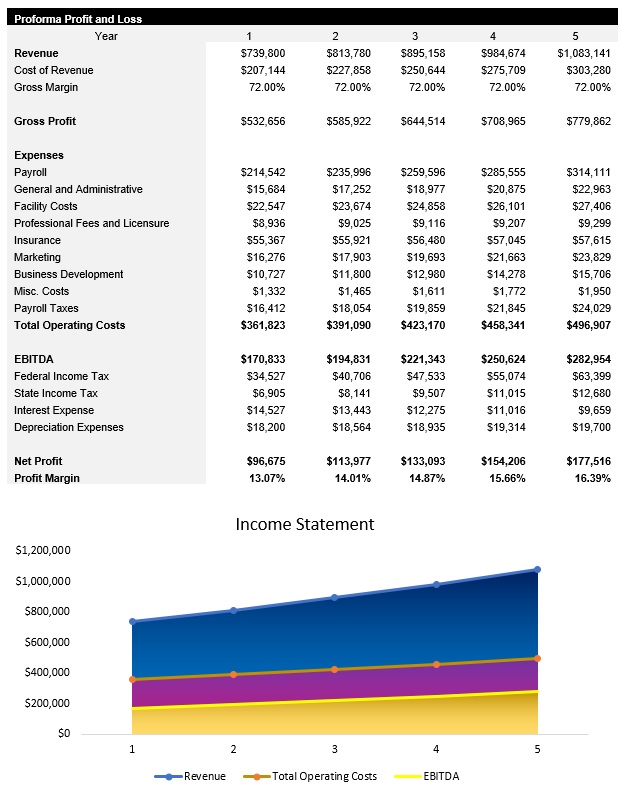
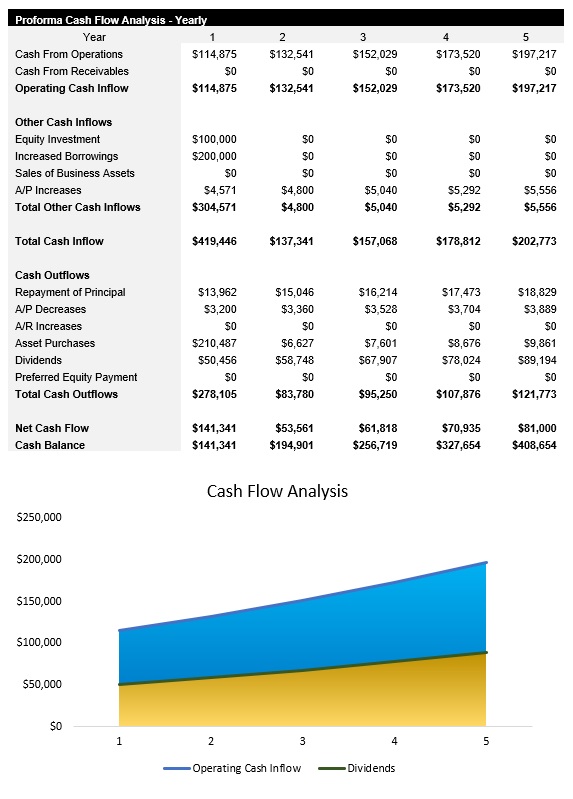
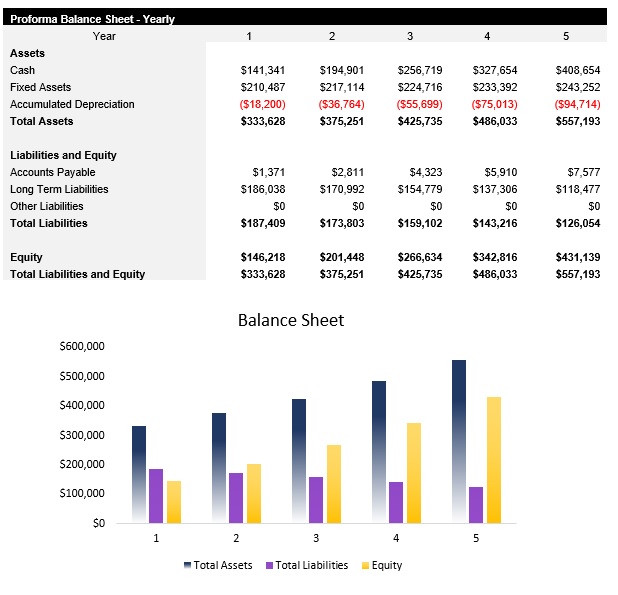
A standard business plan typically includes a three-year to five-year profit and statement, cash for analysis, and balance sheet. These are the three primary financial statements that are present for any type of business. You can also expand the financial to include a common size income statement, breakeven analysis, proforma valuation, business ratios page, as well as a DSCR analysis. The three primary statements look as follows:
Do I need to include operation protocols and procedures in the business plan?
This is typically unnecessary for most business planning purposes. In the event that you are seeking to raise capital with your business plan then you do not need to have a complete section that showcases all of the rules, protocols, and procedures that would be associated with your day-to-day operations. This type of content is more appropriate for an employee handbook or for a dedicated operations plan, which you can reference within the business plan. Again, when the key focus is to ensure that the business plan is no longer that it absolutely needs to be. It is generally assumed that you will have this additional type of content available for when you start your launch.
Should I include my biography in the business plan?
Yes, absolutely. If you have extensive experience in the industry in which you are establishing a venture then you should definitely include a biography that indicates your abilities to effectively operate this enterprise on a day-to-day basis. This type of information can include your prior work history as well as your educational background. It should be noted that within the confines of a business plan a formal biography is usually presented rather than an actual résumé.
Where can I source resources to complete the market research?
The following sources are highly regarded market research firms that provide extensive reporting regarding a wide range of industries:
Once my business plan is completed, what should I do next?
Once you have finalized the first draft of your business plan, one of the best things you can do is have it reviewed by your certified public accountant. These individuals usually have years of experiencing reviewing financial models as well as business plans. They will have the ability to assist you in indicating whether or not the financial model shown is in line with industry standards. Furthermore, they can provide you with ongoing guidance regarding how to properly structure your business as you establish your operations.
How is business plan specific for a loan different than that specific for an investor?
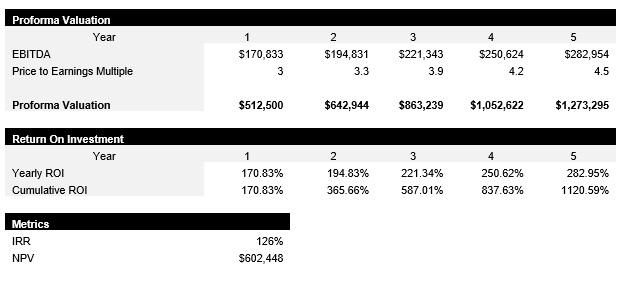
Truthfully, there are very few differences between each type of business plan. The content related to operations, marketing, the market research, as well as the risk analysis are identical. In regards to an investor focused business plan, this typically includes a discussion regarding the percentage ownership of the business as well as a proforma valuation. An indication as to whether or not dividends will be distributed to the private financial partner can also be indicated as well. Below is a sample proforma valuation:
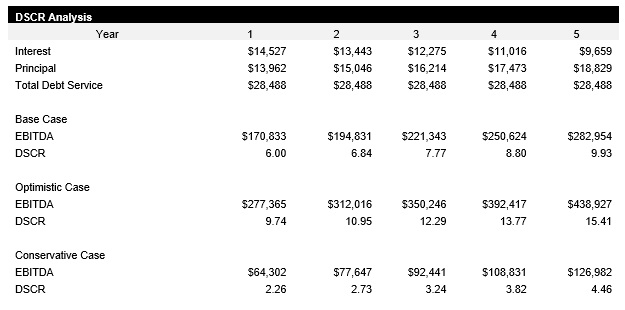
For a business plan that is appropriate for a loan, this is slightly different as principal and interest payments are shown on a monthly and quarterly basis. This type of document also typically includes a debt coverage service ratio analysis to show the business will be generating enough operating income to sustain its financial obligations on a month-to-month basis. Below is a sample DSCR analysis: