
Medical imaging businesses enjoy a substantial degree of economic stability given that they provided medically focused service that remains strong in any economic climate. These businesses are able to thrive in an economic climate, especially as they receive a substantial portion of their revenues through Medicare, Medicaid, as well as insurance reimbursement. When we develop a medical imaging business plan, we take a in-depth approach to developing the financial model so it shows the payer mix based on the patient census. There is a significant degree of complexity when developing a business plan specific for this type of enterprise given the multiple facets of operation, very complex asset acquisition process, the need for highly skilled employees, and other operational complexities that are part and parcel of a medical imaging business.
Our first step is to determine the viability of the business by conducting an extensive amount of market research spanning a 25-mile radius for most suburban areas. In more rural areas, we will expand this target market radius to include cities and towns within a 50-mile radius of the planned medical imaging location. The scope of this analysis includes an overview of the population, percentage of population with insurance, the percentage of population enrolled in Medicare or Medicaid, median household income, as well as median home value. Once we obtain these statistics, we are able to properly form the service obtainable market after we conduct an extensive analysis regarding other competitors that provide medical imaging services within the target market radius.
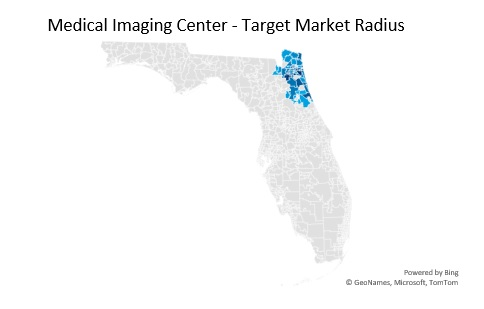
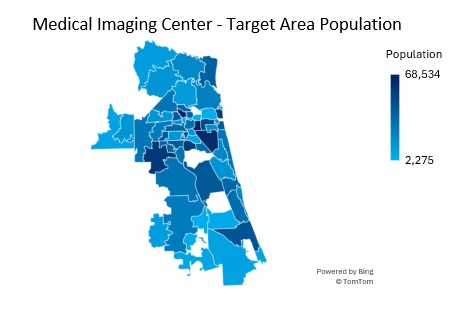
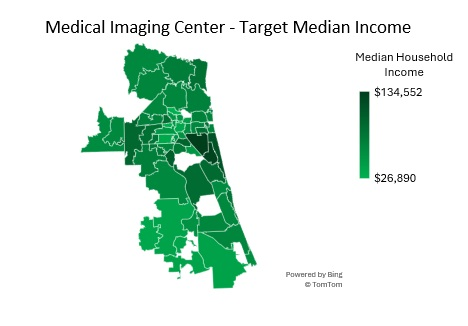
Based on the annual statistics of people that require medical imaging, we then create the revenue profile. Here, we discuss the number of patients that will be seen in any given month as well as anticipating what type of payment they will use to receive their medical imaging. From here, we then develop the profit and loss statement, cash flow analysis, and balance sheet. As part of the financial model, we also always include a sensitivity analysis, breakeven analysis, and applicable business ratios. In the event that debt capital being used to establish the medical imaging facility then we will also include a DSCR analysis.
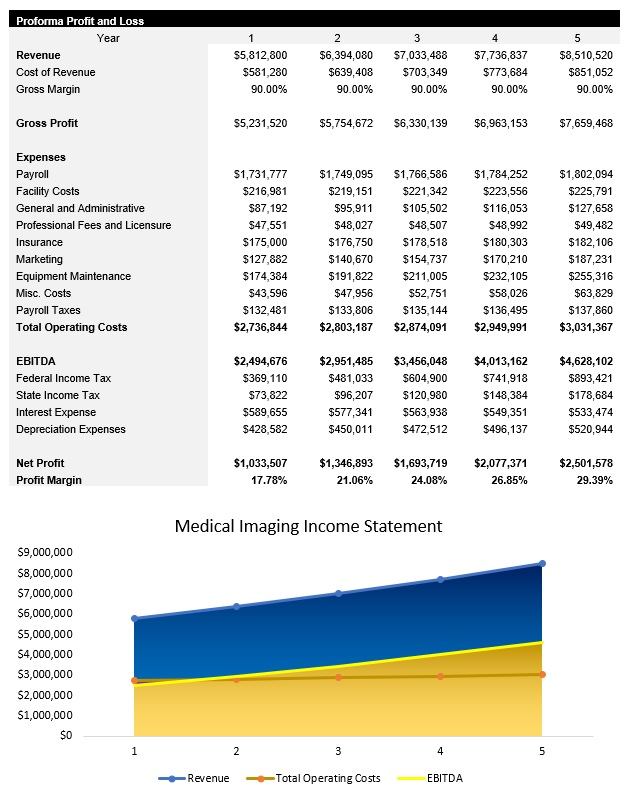
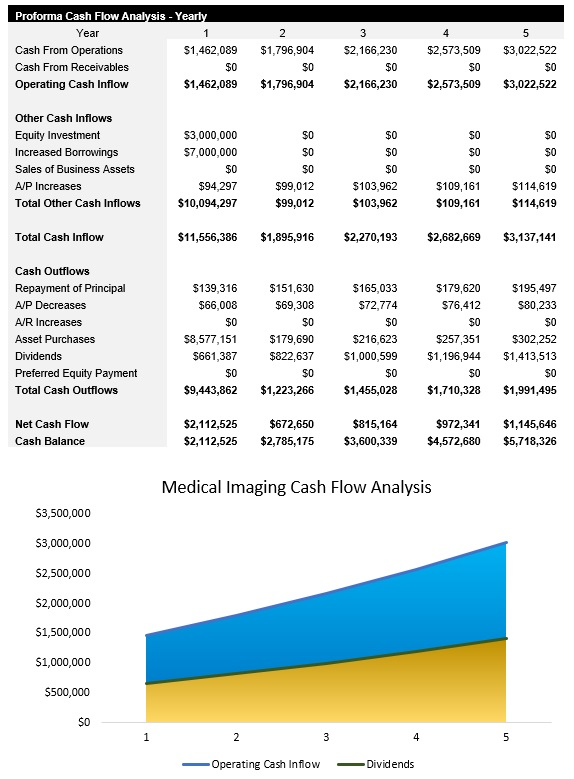
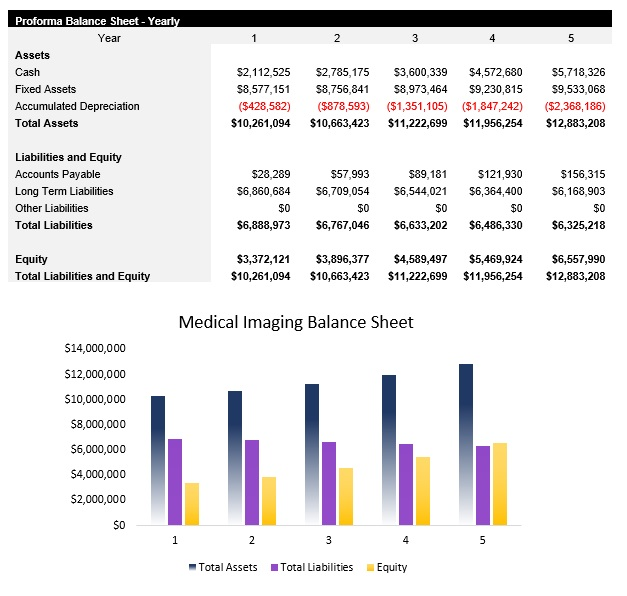
Once these two primary chapters are complete completed, we then move into developing the medical imaging marketing plan. Most importantly, we discuss establishing ongoing relationships with referring healthcare professionals during the pre-launch phase. This allows the medical imaging facility to have a number of people that are ready to use its services at the start of the grand opening. In addition to discussing these direct outreach initiatives, we also discuss the development of a comprehensive website that showcases each aspect of the medical imaging facility’s operations including MRIs, x-rays, CT scans, and ultrasounds. One of the key focuses here is to discuss the use of search engine optimization on both a local and regional basis in order to increase visibility not only among potential patients but also for medical professionals as well.
The fourth chapter we develop is the operations plan in this chapter. We discuss these types of medical imaging that are going to be offered, as well as addressing the human resources issues in regards to either directly employing or retaining staff radiologists. The scope of this discussion further extends to hiring medical imaging technicians, registered nurses, and administrative staff that will be present on a day-to-day basis. Through this chapter as well, we discuss the use of insurance reimbursement from both publicly funded and private insurance carriers.
Beyond these primary chapters, the business plan also features a number of secondary chapters. We develop a risk analysis profile specific for the medical imaging business that discusses potential issues that could occur during the course of operation. This is further extended to include a discussion regarding financing, development risks, and how potential changes in regulation could impact the operations of the medical imaging enterprise.
We also include a medical imaging SWOT analysis, which outlines the strengths, weaknesses, opportunities, and threats. As it relates to the strengths, we focus very heavily on the economic stability of a medical imaging business given that it remains in demand at all times. As it relates to weaknesses, these are highly complex businesses that have multiple facets of operation that need to be addressed on a daily basis. In regards to opportunities, there is always the ability to add additional state of the art equipment at any given medical imaging facility. Additionally, these businesses can scale through the continued development of new locations in other areas. For threats, changes in reimbursement rates can impact the operations of these businesses significantly.
Finally, we come to the medical imaging executive summary. In this chapter, we provide a full overview how the medical imaging center operates, its development plan, financial projection, snapshot, and an overview of the intended market. This provides the reader with a deep yet quick insight as to the operations of this business.